
Property News

Inflation hits 10-year high as energy, fuel and clothing costs jump

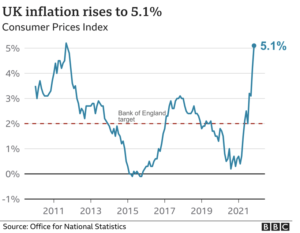
https://urbantribeproperty.co.uk/wp-content/uploads/2021/12/WhatsApp-Video-2021-12-15-at-9.06.46-PM.mp4 With the news today that inflation has risen over 5% and is at it’s highest point in 10 years. I’m doing some digging to understand how banks work, how it may affect interest rates, and what might this mean for house prices in 2022.   Part 1: Is an overview on how banks and lenders are affected by changes to the Bank of England Base rates. ——————————————————————————————————————-         Inflation hits 10-year high as energy, fuel and clothing costs jump The cost of living surged by 5.1% in the 12 months to November, up from 4.2% the month before, and its highest level since September 2011.   Higher transport and energy costs drove the rise, which was above forecasts of a 4.7% increase, the Office for National Statistics (ONS) said.   Its chief economist Grant Fitzner said more expensive fuel, energy, clothing and second hand cars were big factors.   The cost of raw materials also rose significantly, he added. “A wide range of price rises contributed to another steep rise in inflation, which now stands at its highest rate for over a decade,” he said.   BBC headline, Dec 15th 2021     Does an increase in inflation automatically stimulate base rate rises?   When people think about inflation they often associate it with a Bank of England (BoE) interest rise to control the rise, is that likely to happen this time? Well it’s not always the case that a change in the BoE’s rate, either up or down, flows directly through to the market. The reason for that is, because while residential mortgages and Buy to Let mortgages are mostly delivered by banks, they can also be delivered by lenders (as opposed to banks) in the form of bridging for commercial mortgages, development finance. These lenders may or may not be affected by the base rate, depending on where their finance comes from. For banks, who deliver the majority of mortgages in the UK, the way the way an other business works, from a profit and loss point of view; If a mortgages is thought about as a loan, then a loan is a profit and loss statement. The first line of the spreadsheet is the income line, that reflects the interest and fees that you receive from delivering the loan product. Underneath that you’ve got all the costs that come with delivering the product (ie cost of operations; sales staff, underwriters, commissions etc). These are fixed costs and don’t change with the base rate. In addition banks factor in a risk factor for bad debt, where they set aside a percentage of their income against possible default (unemployment escalation, covid increases, cost of living increase etc). And finally you have the cost of capital, which is where the base rate feeds into. All these factors mixed into together will produce an interest offer that they are comfortable with. What you have seen, even though the BoE rates have been at record lows, there wasn’t much margin left on these loans and the cost of finance part of it was relatively small part of the mix. So there wasn’t much room for rates to come down. There wasn’t much room for banks to do a lot, even with base rate coming down because all of their other costs stayed the same.   With the challenger bank and lenders it depends on the sort of source of their funds. They may have had an injection from funds from hedge funds, pension funds, private individuals, so depending on what their particular situation is, they may or may not be directly affected by base rates changes.     Ultimately each bank or lender will have its own view on the world and that will drive the assumptions they make in modeling their loans and therefore where their pricing will go too. 

Read More »

On Business: Finding Motivated Sellers and The Sales Funnel

The property market isn’t like the stock market, where you purchase items for a fixed, predetermined price. It’s more like a street market, where the price is decided by mutual agreement between buyer and seller. As all people are different, you’ll get different outcomes from each negotiation. Emotion has a lot to do with it. If you’re buying or selling your own home, you’ll pay the retail price. But as investors, we want to play the wholesale price. To do this, you don’t go out and look for below market value property. You look for motivated sellers.How do you find them… traditionally, you look for the three D’s: Death Debt Divorce However, during Covid, these three traditional routes have been an anomaly. The government has put a hold on debt/repossessions. Sadly death has crept up. However, with lockdown, the probate process has been slowed down, and everything is taking longer. But happily, the divorces rate has slowed down during this time. But as we come out of lockdown it may give rise to the usual 3D rule and we get back to a feeling of normality! So while this may sound grim, the truth is that you’re finding a solution, a win win for both parties. Debt: If you’re being repossessed, you’re liable for that debt for years after you’ve lost the house. Banks can come after you just when you’re getting back on your feet. In addition, your credit rating falls off a cliff which leads to long term struggles. Therefore, agreeing on a deal, which may be below market value, it’s a lot better than being repossessed by the bank. Divorce: At a time of splitting, it’s an immensely stressful time. Do people really want the hassle of tidying up, organizing the house before people come traipsing around your house checking out your curtains? It just adds to all the stress.Furthermore, in addition, people get caught in the chain, and the purchase falls through. 1 in 3 sales fall through, plus it’s taking something north of 3 months to complete. For an investor, with your power team and access to money and a firm promise, a quick sale can be worth its weight in gold. It’s not similar to the second-hand car market. You can sell it online with lots of tyre kickers or a ‘we buy any car’.You’ll get a cheaper deal, but you’ll walk out of there with cash in your hand. Systemising your luck… Lead Flow funnel You need: 50 leads coming in every month. 10 will meet the criteria 6 will be worth viewing 4 you can offer on (if you get that far, put an offer in). 1 you’ll purchase. To get lucky each month, you need to keep filling the funnel up. Three ingredients to getting a below market deal: Motivation – clear and compelling reason why the seller has to sell. If they’re wishy-washy, they won’t sell. Deadline, they need to be out by X time… i.e. divorce, job move Capacity to accept a BMV deal, i.e. the equity, i.e. if their mortgage is greater than the offer, then it’s not going to work. Toolbox for coming up with finding the solution to their problem. You have to figure out what the problem is for resolving their issue. Too often, people try to offer one solution, i.e. purchase lease option. However, there are many more, delayed completion, vendor finance, assisted sale and many others. So to get the best solution, you need to meet the vendor and find out what they actually want. The magic wand question…..‘if I had a magic wand, where would you like to be at the end of this negotiation’ apart from finding out about their price, more importantly, you’ll find out about their end game and what they’re hoping to achieve. From that, you can work backwards to help them achieve it… Engineer a Solution!

Read More »